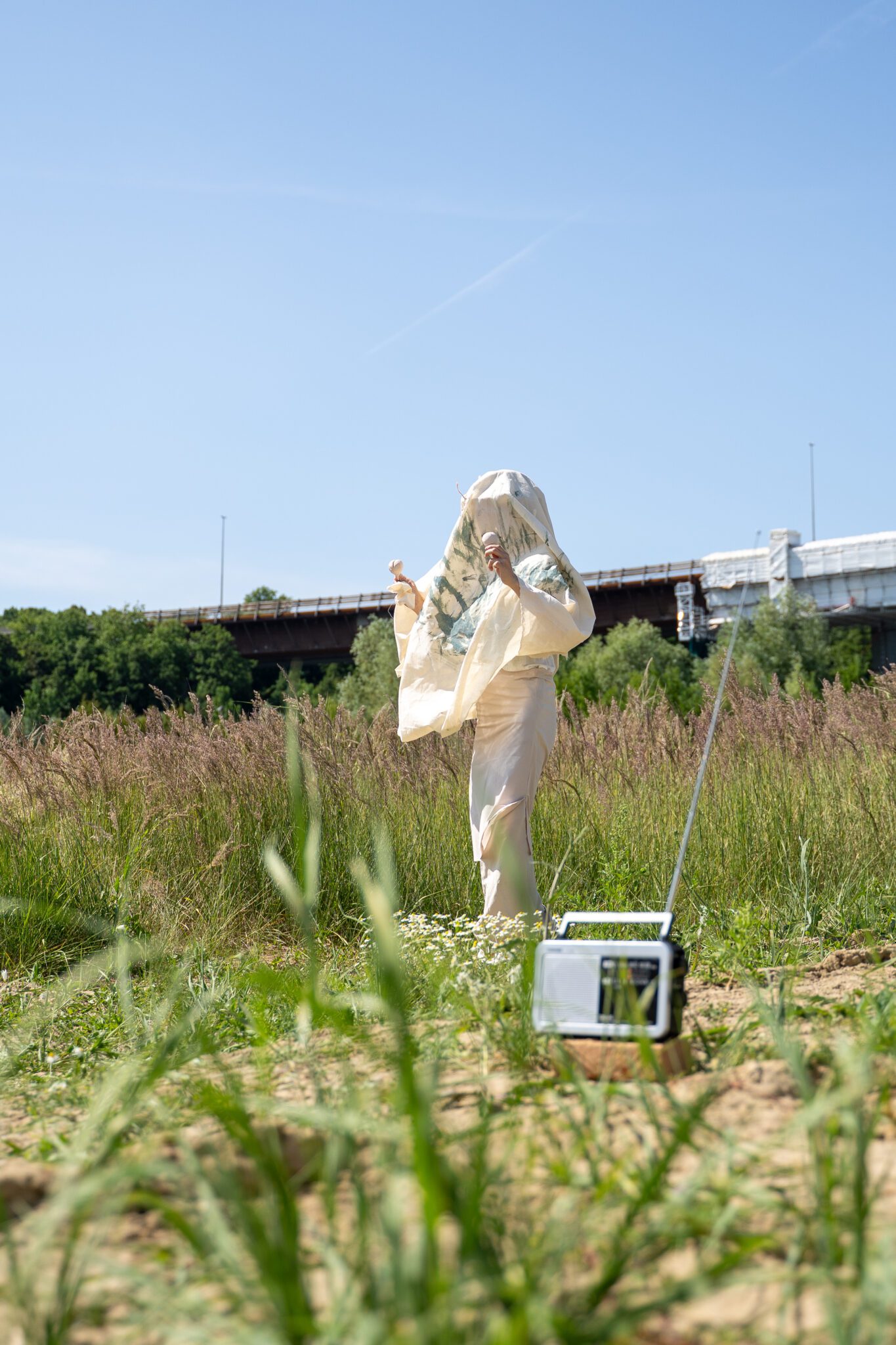
pneuma is a site-specific outdoor performance conceived for a vacant lot in an industrial area in Belgium. The title derives from the Greek word pneuma (πνεῦμα), meaning breath, wind, and spirit. It is also etymologically connected to pneō (πνέω), “to breathe” or “to blow,” suggesting air in motion and breath as something essential to life.

The work began with a strange hole found during field research on the site. When I lowered a hydrophone into it, I heard a dense chorus of insects that was completely inaudible from outside, and strangely out of place in the surrounding industrial landscape. By the time I returned, the hole had already been filled in. This encounter revealed a temporary ecosystem hidden inside the land: a layer of sound that could not be heard from the surface, and the fragility of a place that might disappear at any moment.

The vacant lot itself was also a provisional space. Although it appeared empty and ownerless, it was easy to imagine that, situated within an industrial area, it would soon be developed or absorbed into another use. pneuma listens to this kind of place: still present, yet already beginning to vanish.

Several radios were placed in the performance site, receiving narration and sound materials transmitted through a small transmitter. The audience listened to the radio sounds, the actual environmental sounds of the vacant lot, and the performers’ actions as overlapping layers. Voices, insect sounds, recordings of aeolian harps, and field recordings drifted through the site via radio waves, sometimes interrupted by noise, instability, and signal interference. These fragile transmissions made perceptible the invisible medium of radio waves, affected by air, distance, and the conditions of the site.

The performers also created wind with handheld fans, disturbing the air that carries sound and temporarily connecting breath, radio waves, soil, and bodies. Instruments made from the soil of the site were played, and small clay balls made from the same earth were handed to the audience as part of the ritual. Held in the palm, these clay balls became both a memory that could be taken away and a trace of the living presence that had once resonated inside the now-filled hole.

Through breath and wind as fragile media, pneuma calls forth invisible presences and forgotten memories lingering at the edge of the urban and industrial landscape. Disturbed air, faint sounds, radio noise, soil, and bodily gestures form a temporary relation with what exists beyond the visible. The work is a quiet attempt to attune oneself to what has been silenced, buried, or is about to disappear, and to listen, even briefly, to its remaining presence.

《pneuma》は、ベルギーの工業地帯に残された空き地を舞台に構想された、サイトスペシフィックな野外パフォーマンスである。タイトルの pneuma は、ギリシャ語の πνεῦμα に由来し、「息」「風」「霊」を意味する。また、「息をする/吹く」を意味する πνέω と結びつき、「動いている空気」や生命に不可欠な呼吸を含意している。

本作の出発点となったのは、現地調査中に見つけた土地の大きな穴である。そこに水中マイクを垂らすと、外からはまったく聞こえない、工業地帯には似つかわしくないほど濃密な虫の大合唱が聞こえてきた。しかし次に訪れた時、その穴はすでに埋められていた。この経験は、土地の内部に一時的に存在していた生態系、外からは聞こえない音の層、そしてすぐに失われてしまう場所の儚さを示していた。

舞台となる空き地もまた、現代の都市においては極めて暫定的な存在である。所有者が明確には見えず、まだ何も建てられていないように見える一方で、工業地帯の中にあるその土地はいずれ開発され、別の用途へと変えられていくことが容易に想像される。《pneuma》は、このような「まだ残っているが、すでに消えかけている」場所に耳を澄ませる試みである。

会場には数台のラジオが置かれ、トランスミッターから送られるナレーションや音源を受信する。観客は、その場に響くラジオの音、空き地の実際の環境音、そしてパフォーマーの行為を重ね合わせるように聴く。声や虫の鳴き声、エオリアンハープの録音は、電波に乗って空き地に漂い、時にノイズに遮られ、途切れ、揺らぐ。その不安定な受信は、目に見えない媒体が、空気や距離、その場の条件に影響されながら空間を満たしていることを示している。

また、うちわで起こされる風は、音を運ぶ空気をかき乱し、息、電波、土、身体を一時的に結びつける。パフォーマーは、その土地の土から作られた楽器を鳴らし、同じ土で作られた小さな玉を観客へ手渡す。手のひらに包まれた土の玉は、持ち帰ることのできる記憶であると同時に、かつて穴の奥で鳴っていた、すでに埋められてしまった生の気配の名残でもある。

《pneuma》は、息と風という儚い媒体を通じて、都市と工業の境界領域に漂う見えない存在と、忘れ去られた記憶を呼び覚ます儀式である。かき乱された空気、微かな音、身体的なジェスチャーは、可視の彼方にあるものとの一時的な交わりをつくり出す。それは、沈黙させられたもの、埋められたもの、消え去ろうとするものへと自らを調律し、たとえ一瞬でも、その気配に耳を傾けようとする静かな試みである。

Credit
Pneuma (2025)
’30 site specific performance
Commissioned by, and premiered at the Border Buda Festival 2025

Concept: Tomoko Hojo
Performers: Charles Monnier, Fabian Schoog, Tomoko Hojo
Narration: James Umansky, Tomoko Hojo
Costume: Fabian Schoog, Tomoko Hojo
Materials: Self-made instruments (bell and flute), ceramic balls, Fans, Self-made costume, Radios, Radio transmitter, Audio
Instrument Making: Kosi Hidama
Recording: Yamato Sekiguchi
Technical Help: Keita Hori
Supported by Acoustic Design Course, Kyushu University, QO2

Border BUDA Festival, The Woman Who Thought She Was A Planet / 2025
20. 06. – 22. 06 2025 at outside field [Buda, Belgium]

Photo: Rita Maria Habib